
Reviewed by: Irit van der Veldt
Seen and heard: September 5, 2026, at Dutch National Opera (DNO) in Amsterdam
Dutch National Opera opened its 2026 season with a double bill centered on infidelity and adultery. Written close together in the late 19th century and later combined into a single evening, both short operas share a foundation of love, betrayal, and honor killings. Their shared history also includes triumphant premieres, set to gorgeous, Puccini-like music that remains accessible while making the spectacle easy to connect with.
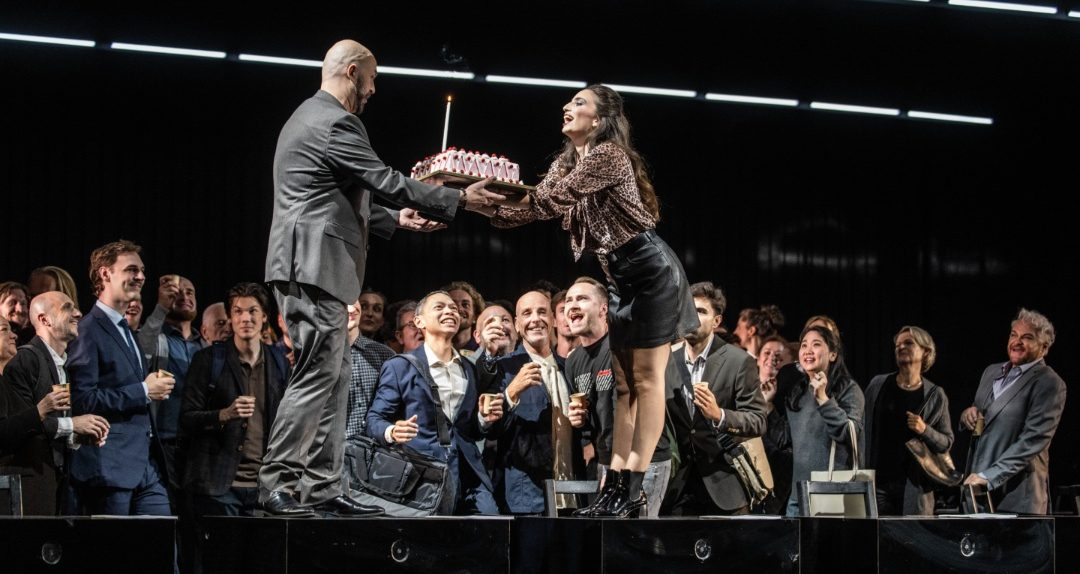
In the transition from Pagliacci to Cavalleria rusticana, the chorus stands as a massive, carefully sculpted structure around the dead lovers. Under subtly chosen lighting, some look away, others appear astonished, and a few stare blankly ahead—acting almost as a single entity. This scene sharply highlights the core tension: the act of watching and being watched. Roleplay, social pressure, and subjectivity take center stage as the production plays with the line between performance and reality.
DNO opened the season by reviving director Robert Carsen’s acclaimed production—a return driven by its previous success and the enduring relevance of its themes. Instead of setting the story in a rural village rife with gossip, Carsen places it inside an opera house, shifting the drama to a community of choristers, actors, and musicians exhibiting that very same behavior.
Carsen reverses the traditional order, opening with Pagliacci. The story follows a traveling theater troupe performing a comedy led by Canio, who plays the clown Pagliaccio. When Canio discovers that his wife, Nedda, is having an affair with Silvio, he is torn apart. As an actor, he must play the laughing clown on stage, but as a man, he is consumed by rage. Stepping into his costume, he sings “Vesti la giubba” (Put on the costume), forced to make the audience laugh while breaking inside. Driven by despair and the damage to his reputation, he kills the lovers Nedda and Silvio mid-performance. The lesson: people are trapped by the judgment of others, forced to play roles dictated by society.
Cavalleria rusticana follows four people bound together by love on Easter Sunday. Santuzza is devastated when she sees her lover, Turiddu, kiss his former flame, Lola. Seeking comfort from Turiddu’s mother, Santuzza ultimately ends up isolated and excluded by the community. In desperation, she reveals what she saw to Lola’s husband, Alfio, who takes revenge by killing Turiddu.
Joyful, hopeful Easter music stands in stark contrast to Santuzza’s heartbreak and the betrayal surrounding her. As the chorus sings of Christ’s resurrection, her suffering is laid bare. Everyone watches and judges one another, yet no one sees what lies beneath the surface. Santuzza becomes the abandoned woman, Turiddu the strong man, and Alfio the wronged husband. The community reinforces these predefined roles, keeping each character trapped by public perception.
The Audience Participates
Before the show begins, drumbeats echo through the DNO foyers, inviting the audience to “take part” in the performance. The tone is set instantly; the boundary between reality and theater disappears. With the opera chorus, select musicians, and a children’s choir seated among the audience, it becomes clear that passive viewing is not an option—the spectators themselves play a role in the misery.
Inside the auditorium, red velvet theater curtains on the front and mid-stage reinforce the play-within-a-play concept, continuously asking: who is watching, and who is being watched? When the stage rotates 180 degrees, a dark backstage rehearsal space appears, surrounded by black spotlights. Folding vanity tables with bright mirrors open up to create a dressing room. Here, performers switch roles using makeup and costumes, yet put on the same everyday outfits time and again.
Sublime Musicianship
To bring out the full depth of verismo, DNO brought in Italian conductor Andrea Battistoni. He infuses the orchestra with the exact measure of emotion and passion needed to bring the drama to life. The dynamic, deeply emotional orchestral sound gives the singers a powerful foundation.
The outstanding bariton—returning after performing in the production seven years ago—delivers strong performances as both Tonio the clown and the jealous, vengeful Alfio in Cavalleria rusticana. Corinne Winters shines as Nedda, a compelling new addition to her repertoire, while Maria Warenberg makes a mark as Lola, an emerging star at DNO.
Finally, the chorus sings and acts with stunning power and compassion, forming the backbone of the stage design. Their tight, dynamic, and disciplined movement drives the performance forward—a winning combination that makes this revival another box-office hit for 2026.